Atonement (2026) Review Roundup: Reed Van Dyk's Iraq War Drama Is Getting the Best Reviews of the Fall
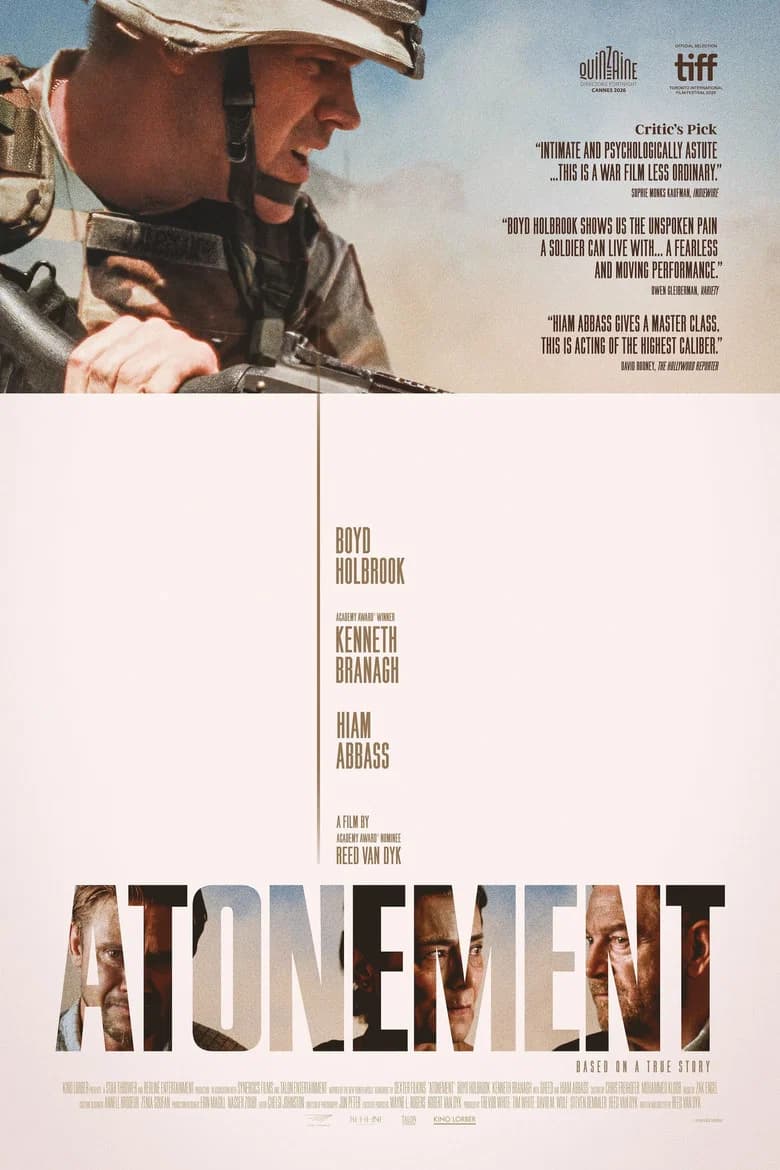
There are two films called Atonement, and they have nothing to do with each other. The one most people picture is Joe Wright's 2007 adaptation of Ian McEwan's novel, the Keira Knightley–James McAvoy drama about a childhood lie that destroys two lives across a world war. This is not that film. This Atonement is a 2026 Iraq War drama, the feature directorial debut of Reed Van Dyk, and it opens in US theaters tomorrow, October 2, through Kino Lorber. It has already played Cannes and TIFF, and the reviews coming out of both festivals are strong enough that this is worth sorting out now, before the wider release muddies the title further.
What Atonement Is Actually About
Van Dyk also wrote the screenplay, adapting it from Dexter Filkins' 2012 New Yorker article of the same name. The film follows Lou D'Alessandro (Boyd Holbrook), a discharged US Marine who, roughly a decade after his unit opened fire on an Iraqi family during a 2003 firefight in Baghdad, killing the men of the household, goes looking for some form of reconciliation. He reconnects with journalist Michael Reid (Kenneth Branagh), who helps broker a meeting in California with Mariam Khachaturian (Hiam Abbass), an Iraqi Christian woman whose family members died in the incident. Gheed plays Nora, Yara Bakri plays Anna, and Kalama Epstein plays Pat, rounding out a cast built around three generations of grief and guilt colliding in a single room, according to Wikipedia's plot summary of the film.
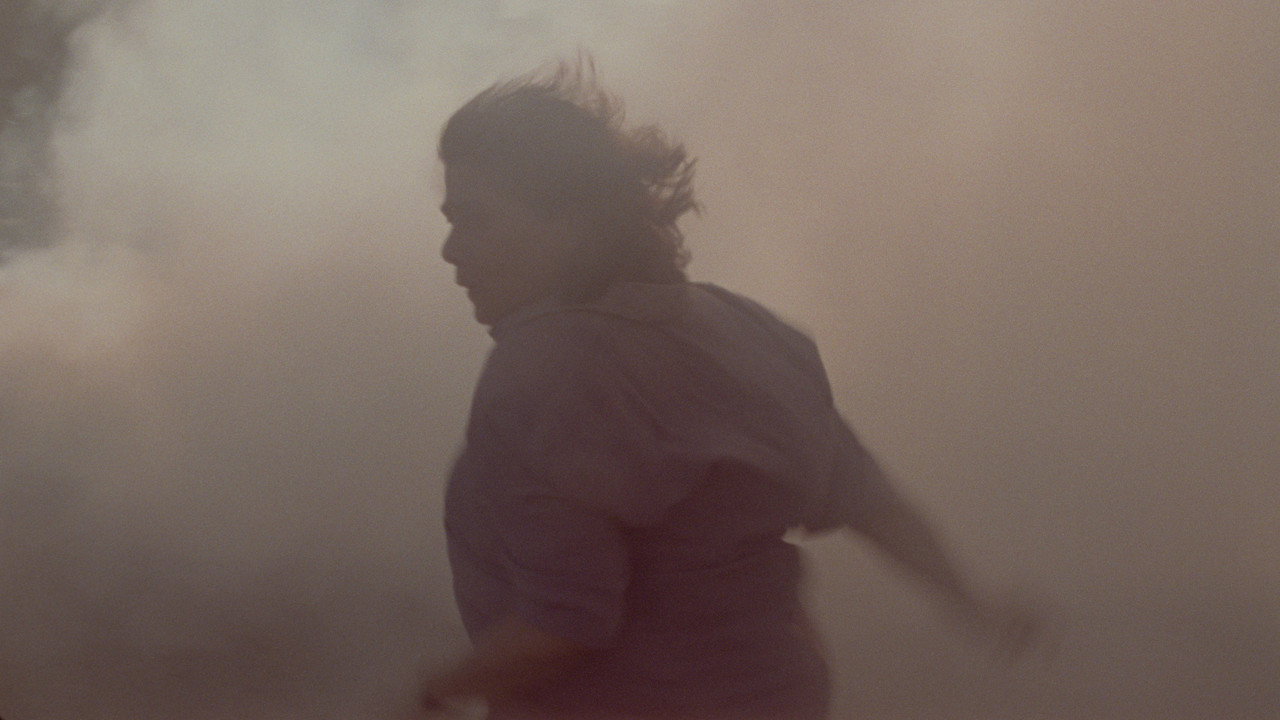
That's a tight, uncomfortable premise, and it's one that puts the film in direct conversation with a specific tradition of American war cinema that usually centers the soldier's trauma almost to the exclusion of everyone else affected by it. Based on the early reviews, Atonement goes out of its way not to do that.
The Festival Run So Far
Atonement premiered on May 15 at Cannes, in the Directors' Fortnight sidebar, where it picked up a nomination for the Caméra d'Or, the festival's prize for first-time feature directors. It played again on September 15 at the Toronto International Film Festival. Those two stops gave critics roughly four months of runway to write about it before Kino Lorber's theatrical release, and the aggregate numbers reflect a film that's landed well with nearly everyone who's seen it. Rotten Tomatoes currently has it at 89% fresh from 18 reviews, with a 7.9-out-of-10 average score — a number high enough that the "fresh" percentage and the underlying average actually agree with each other, which isn't always the case on this site. Metacritic has it at 76 out of 100 from 11 critics, landing in that site's "generally favorable" band, a notch below Rotten Tomatoes' enthusiasm but still comfortably positive.
Eighteen and eleven critics respectively is a small sample compared to the hundred-plus-review hauls a wide studio release tends to generate in its first week, and that's worth keeping in mind. But a small sample this consistently positive, gathered across two separate festival circuits months apart, is a meaningfully different situation than an early buzz score that could swing wildly once more critics weigh in. This is reviews out of Cannes and TIFF settling into a real, reasonably stable consensus ahead of a wide release, not a first-weekend snapshot still finding its level.
Screendaily's Jonathan Romney Has the Most Detailed Take
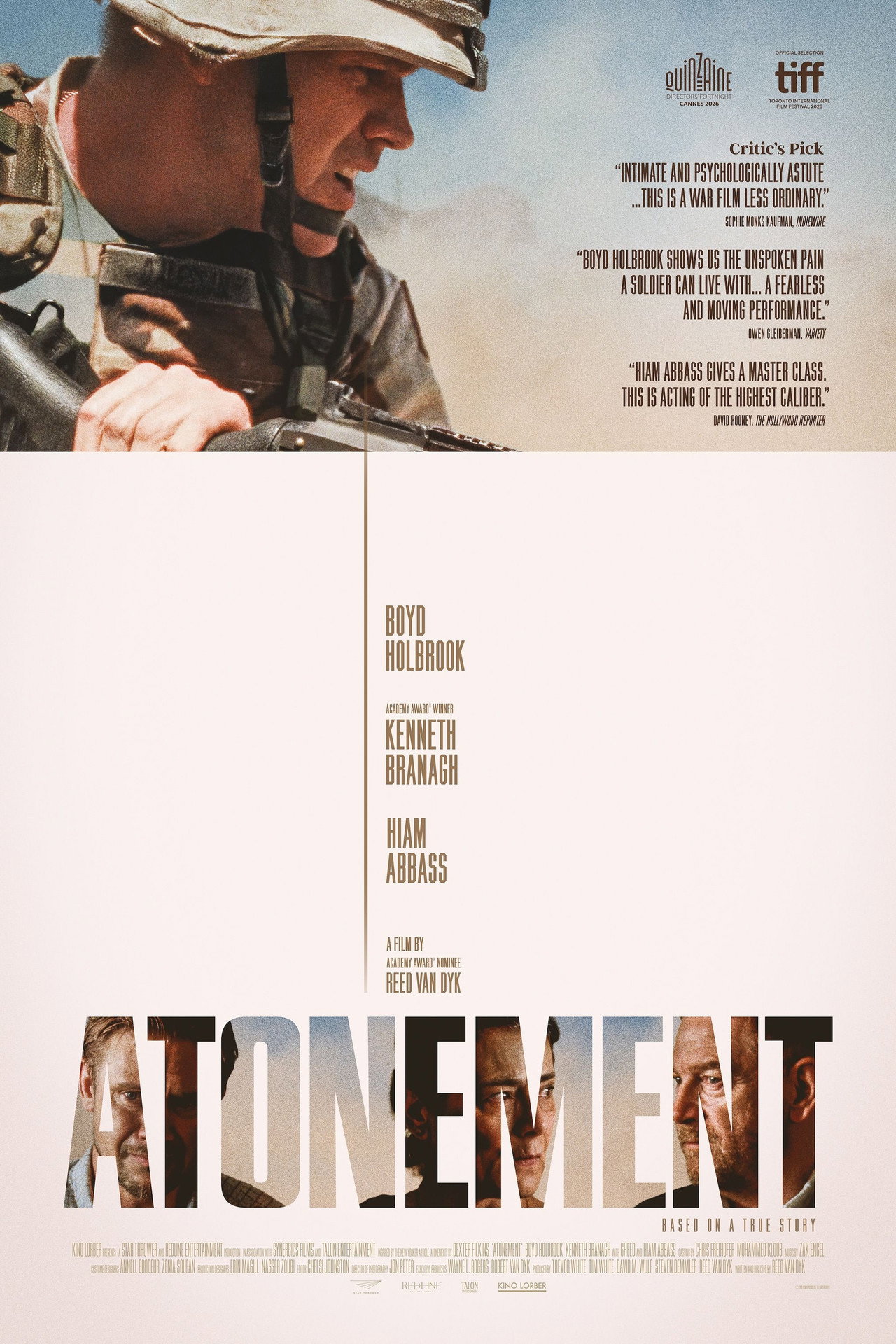
Of the reviews available in full, Screendaily's Jonathan Romney offers the most specific and most useful read on what the film actually does well and where it falls short. Romney calls Atonement "an involving, soberly executed drama," and argues that it "successfully questions Hollywood clichés of war drama" — a direct way of saying the film is aware of the genre conventions it could have leaned on and makes a deliberate choice not to.
Romney singles out Hiam Abbass's performance as the film's strongest element, describing her as "characteristically magnetic." That's a notable callout given the character she's playing: Mariam isn't the soldier working through his own guilt, she's the woman on the other end of that guilt, and Romney's review treats her performance as the emotional center of gravity the film is built around rather than a supporting fixture orbiting Holbrook's arc.
The review isn't a total rave, though. Romney flags "a couple of too-rhetorical music choices" as a real weakness, along with dialogue that occasionally tips into heavy-handedness — the kind of on-the-nose writing that can undercut a film this otherwise committed to restraint. Those are specific, legible complaints rather than vague hedging, which makes them worth taking seriously even inside an overwhelmingly positive review.
A Film That Picks a Side, Deliberately
The detail from Romney's review that matters most for understanding what kind of film this is: Atonement deliberately favors the Iraqi victim's perspective over the American soldier's. That's a structural choice, not an incidental one, and it's the thing that separates this film from the bulk of American Iraq War cinema that came before it. Films like American Sniper or The Hurt Locker are built around the psychology of the soldier, with the Iraqi civilians on the other side of the conflict functioning mostly as context for that psychology. Atonement, per Romney's reading, inverts that weighting. Lou is the one seeking atonement, but the film's sympathy and screen time lean toward Mariam, the woman he's seeking it from — and whether that reconciliation is even possible, or whether it's a comfort the film is willing to deny its protagonist, is the tension the story is built around.
That choice also explains why Romney predicts a tough domestic box-office path for the film despite the reviews. A film this interested in centering an Iraqi family's grief over an American soldier's redemption arc isn't built for the kind of mainstream theatrical run that a more conventional war drama might get, according to Romney's assessment. He suggests the film is more likely to find its audience internationally and on the awards circuit than at the US box office in its opening weeks — a prediction that tracks with how Kino Lorber, a specialty distributor built around arthouse and awards-adjacent titles rather than wide commercial releases, has positioned the rollout.
IndieWire's Headline Points the Same Direction
IndieWire also reviewed the film, and while the full text sits behind a paywall, the headline alone is worth noting for how plainly it states its verdict: "'Atonement' Review 2026: True, Emotionally Powerful Anti-War Film." That's a headline-level signal rather than a substitute for the actual review, so it's worth being careful not to read specific arguments into it that aren't there. But paired with Romney's more detailed take, it points in the same direction — a film being received as a genuine, effective entry in the anti-war genre rather than prestige-drama Oscar bait going through the motions.
A handful of other outlets have also published reviews, including Moveable Fest, Frame Dispatch, The Berkshire Edge, Yahoo Entertainment, and The Rolling Tape. Those reviews haven't been independently verified in detail here, so treat their existence as additional signal that the critical conversation around this film is broad rather than confined to two or three major outlets, without attributing specific claims to any of them.
The Craft Behind the Camera
Atonement was shot on 16mm film by cinematographer Jon Peter, with production split between Dallas, Texas and Amman, Jordan standing in for the film's Iraqi and American settings. Shooting on 16mm for a film this grounded in grief and memory is a deliberate textural choice — the format tends to produce a grainier, warmer, less polished look than digital, which fits a story more interested in intimate rooms and difficult conversations than in the kind of sweeping, high-gloss combat photography that defines a lot of mainstream war cinema. The film runs 118 minutes and was produced through Star Thrower Entertainment and Talon Entertainment.
That production footprint also tells you something about the film's scale and ambition. This isn't a studio war epic with a nine-figure budget and a marketing campaign to match. It's an independently produced first feature built around three central performances and a tightly scoped story, which lines up with the Caméra d'Or nomination at Cannes — a prize specifically designed to recognize exactly this kind of debut filmmaking, rather than studio prestige product.
Why the Dexter Filkins Source Material Matters
Filkins is a war correspondent whose reporting on Iraq and Afghanistan, including his 2008 book The Forever War, has long been considered some of the most clear-eyed American journalism on those conflicts. His 2012 New Yorker article "Atonement" told the real story that inspired this film's plot, and adapting a piece of journalism this specific — built around real reporting on a real kind of aftermath, rather than a fictionalized composite of "what Iraq War guilt might look like" — plausibly explains why critics keep describing the film as avoiding genre clichés. A screenplay adapted from on-the-ground reporting has a built-in resistance to the more melodramatic shortcuts a wholly invented war-guilt narrative might reach for, since the underlying material was never shaped to serve a three-act redemption arc in the first place.
Van Dyk writing his own adaptation, rather than handing the article to another screenwriter, also matters here. Directorial debuts built around material the filmmaker adapted personally tend to carry a tighter, more singular point of view than directing-for-hire situations, and the specificity Romney's review credits — the deliberate choice to favor Mariam's perspective over Lou's — reads like exactly the kind of structural decision that comes from a writer-director who spent real time with the source material rather than someone executing someone else's draft.
Where This Leaves the Film Going Into Wide Release
Put all of it together and Atonement looks like a film arriving at its US theatrical release with more critical goodwill than almost anything else opening this fall. An 89% Rotten Tomatoes score and a 76 on Metacritic, both built on real festival-tested reviews rather than early hype, are strong numbers for any film, let alone a first-time director's adaptation of a magazine article about an Iraq War atrocity. The specific praise — Abbass's performance, the film's refusal to center the American soldier's catharsis over the Iraqi family's grief, the soberness Romney credits it with — all points toward a film that earned its reception rather than coasting on festival-circuit goodwill alone.
The open question, which Romney's own review raises directly, is whether any of that critical enthusiasm translates into an audience willing to buy a ticket to a quiet, deliberately uncomfortable drama about an American war crime, rather than a more conventionally cathartic war film. Kino Lorber's specialty-distribution model means nobody involved is likely expecting a wide commercial breakout, and the more realistic path for a film like this runs through continued festival and awards-circuit attention rather than box office charts. Whether that's the shape Atonement's afterlife actually takes should become clearer over the next few weeks, once a full week of wide-release reviews and whatever opening numbers Kino Lorber reports are available to compare against this festival-era reception.
A wider wave of reviews should land alongside tomorrow's US theatrical opening, along with a first real read on whether the subject matter can find an audience beyond festival crowds.