Hanuman Ansh's Box Office Turnaround: How a ₹10 Lakh Opening Became 2026's Most Profitable Hindi Film

Most Hindi films that open to ₹10 lakh on day one don't get a second act. They get pulled from theaters within the week, written off in a two-line trade report, and forgotten. Hanuman Ansh was tracking exactly that path in its first seven days. By day 26, it had become one of the most talked-about box-office stories of 2026 — not because of its size, but because of the math. On a budget reported at roughly ₹2 crore, the film has reportedly climbed past ₹50 crore, and at least one outlet has done the arithmetic to argue it's proportionally the most profitable Hindi release of the year, ahead of films that made forty times more money.
What the film actually is
Hanuman Ansh is a Hindi-language spiritual biopic written and directed by Vishal Chaturvedi, adapted from his own book Divine Detour, according to Wikipedia and BusinessToday. It's produced under Swambhu Media Network, with Ragini S, Namrata G Singh, Anupriya A Nagar, and Chaturvedi himself credited as producers. The film chronicles the life of Neem Karoli Baba, the guru whose devotees over the decades have reportedly included Apple co-founder Steve Jobs, Meta CEO Mark Zuckerberg, and Be Here Now author Ram Dass, born Richard Alpert. One outlet, Asianet Newsable, has also reported that Virat Kohli was once spotted with a photo of Baba as his phone wallpaper — a detail worth flagging as single-sourced and not independently corroborated elsewhere, unlike the Jobs and Zuckerberg connections, which are more widely documented pieces of Neem Karoli Baba lore.

Shobhinav Satya — credited in at least one source as Shobhinaw Satyaa — plays Neem Karoli Baba, with a supporting cast that includes Chandan K. Anand, Anil Rastogi, Purnima Tiwari, and Vihaan Shedge, per Wikipedia and BusinessToday.
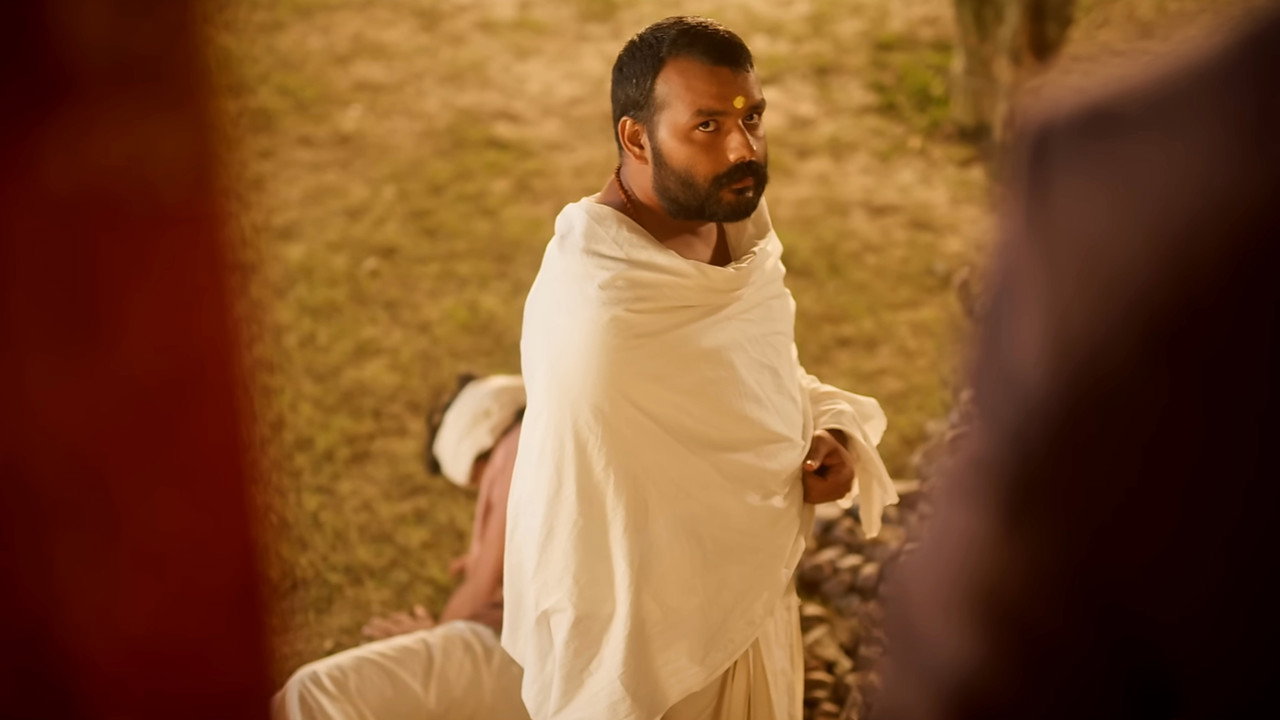
The film was originally slated for a July 31, 2026 release before being pushed to August 7, 2026, according to Wikipedia. (One outlet, Asianet Newsable, lists a June 7, 2026 release date, which conflicts with both Wikipedia's and BusinessToday's timelines. Given the inconsistency and the corroboration between the other two sources, August 7 is the more reliable date to go with here.)
A near-flop opening
There's no dressing up how Hanuman Ansh opened. According to BusinessToday and Sacnilk, the film collected just ₹10 lakh net on day one. For context, that's the kind of number that barely covers a single day of marketing for a mid-budget release, let alone a theatrical run. The trend didn't reverse quickly, either — Oneindia reports that the film's entire first week added up to only ₹1.08 crore net, a total so low that, per multiple reports, the film was reportedly on the verge of being pulled from theaters altogether.
This is normally where the story ends for a small spiritual film with no major stars and no studio marketing push behind it. Exhibitors don't hold screens for films that aren't selling tickets, and a week-one number that low usually triggers exactly that response — shows get cut, screens get reassigned to whatever's opening next, and the film quietly disappears from listings within a fortnight.
That's not what happened here.
The turn: weeks three and four
Instead of losing shows, Hanuman Ansh gained them. According to Oneindia and BusinessToday, word of mouth and social media discussion around the film started building through week two, and by week three, the numbers had moved in a way that's genuinely unusual for a film that nearly got pulled seven days after release. Week two collections were modest — reported figures range from roughly ₹0.40 crore to ₹1.30 crore depending on the source — but week three jumped to approximately ₹10.40 crore, roughly a tenfold increase over the previous week's number.
That kind of trajectory almost never happens by accident. Films with big opening weekends and no legs decline steadily from day one onward; that's the standard shape of a Bollywood box-office run, driven by front-loaded marketing and opening-weekend curiosity that fades fast. Hanuman Ansh did the opposite: a catastrophic opening followed by a sustained, accelerating climb, which is a pattern that only really shows up when audiences who've already seen a film are actively convincing other people to go watch it. For a spiritual biopic with a book source, a first-time-to-most-audiences director, and no major stars, that word-of-mouth engine appears to have been the entire marketing budget.
Exhibitors evidently noticed the trend in real time and responded by adding shows in weeks three and four rather than cutting them — a decision that, per the reported numbers, paid off directly.
Where the numbers stand now
Box-office totals for a film still climbing are inherently a moving target, and the reported figures vary somewhat by source and by exactly which day they're counting from. Here's the range as reported around September 1-2, 2026:
- Wikipedia (as of September 1): ₹55.71 crore gross, ₹48.78 crore net.
- Sacnilk: a worldwide total of ₹63.82 crore gross and ₹54.13 crore net, spread across a reported 34,208 total shows.
- BusinessToday (day 26): ₹54.39 crore gross in India.
- Oneindia (24 days): ₹47.33 crore net, with the film's makers reportedly targeting ₹50 crore.
None of these numbers are wildly out of line with each other — they're all clustered in the ₹47-64 crore range depending on gross versus net and the exact cutoff date — but they shouldn't be treated as one settled figure. This is a film whose total is still being counted in real time, and the discrepancies are best read as different snapshots of the same climbing curve rather than any single source getting it wrong.
The ROI argument
Here's where the story gets genuinely interesting from a business standpoint rather than just a feel-good underdog angle. On a reported production budget of roughly ₹2 crore — Wikipedia and Oneindia both cite figures in the ₹1.8 crore to ₹2 crore range — a cumulative total anywhere in the ₹47-64 crore range represents an extraordinary return. Oneindia has done the specific math here, calculating roughly a 2000% return on investment, and it's worth being clear that this is Oneindia's own analysis and framing rather than an official figure released by the producers or Swambhu Media Network. There's no confirmation the studio itself has put out a formal ROI statement, but the underlying arithmetic — a low-single-crore budget against a collections total in the tens of crores — checks out regardless of exactly whose spreadsheet it came from.
Oneindia explicitly used that math to draw a comparison to Dhurandhar 2, this year's biggest Hindi release by raw numbers. That film, made on a reported ₹225-250 crore budget, has collected somewhere north of ₹1,177 crore net in India and roughly ₹1,829 crore worldwide by its 50-day mark, according to Koimoi — a return on investment in the neighborhood of 400-600% depending on which total you're measuring against. Both films are genuine hits by their own scale. But Oneindia's argument is that measured purely as a ratio of money in to money out, the tiny spiritual biopic that almost got pulled from theaters in week one has outperformed the record-breaking spy epic several times over.
It's a legitimate point, and also one worth holding with a little perspective. A 2000% return on ₹2 crore and a 400% return on ₹225 crore are very different businesses to be in if you're an investor, a studio, or an actor negotiating a paycheck — absolute numbers still matter enormously in an industry where distribution deals, theater rentals, and star fees are all priced in real rupees, not percentages. But as a story about efficiency, about how far a film can travel on almost no budget if the content connects with the right audience, Hanuman Ansh is a legitimately rare case this year, and one that's drawing comparisons to Toxic too — Yash's much bigger, much more expensive pan-India epic that opened the same month to a very different kind of box-office conversation.
What critics reportedly said
Away from the box-office numbers, the reported critical response to Hanuman Ansh has been positive without being a rave, in the 3 to 3.5-star range according to available reporting, with reviewers reportedly praising the film's "honest intent" and its spiritual message. It's worth being upfront that no single named critic or specific outlet review could be confirmed for this piece — the reported response is being treated here as a general, hedged summary of critical reception rather than attributed to any particular reviewer or publication. That's a meaningfully different situation from Dhurandhar 2 or Toxic, both of which have specific, attributable named reviews on record. For Hanuman Ansh, what exists publicly is closer to a general sense of positive-but-modest critical reception, and it should be read with that caveat attached.
What does seem consistent across the reporting is that the positive reception, whatever its exact source, lines up with the box-office trajectory — a film that built an audience gradually through people telling other people it was worth seeing, rather than one that opened big on marketing muscle and then faded.
Why this kind of turnaround is rare
It's worth sitting for a second on just how uncommon this shape of box-office run actually is in Hindi cinema. The overwhelming majority of theatrical releases live or die in their first three days. Distributors buy screens based on pre-release buzz and star power, exhibitors allocate shows based on opening-weekend demand, and by the time word of mouth would normally have a chance to build, most small or mid-budget films have already lost most of their screens to the next week's releases. The system is built around front-loaded demand, which is exactly why big-star openings dominate headlines and why films without major stars rarely get the runway to build an audience slowly.
Hanuman Ansh getting that runway — surviving a ₹10 lakh opening day and a ₹1.08 crore first week without being pulled, then actually gaining shows in weeks three and four — suggests either an unusually patient distribution partner, an unusually motivated core audience willing to keep showing up and talking about it, or some combination of both. Given the film's subject matter, a devotional audience built around Neem Karoli Baba's following seems like the most plausible explanation for that kind of sustained, self-reinforcing demand — the sort of audience that doesn't need a trailer or a star cameo to show up, just word that the film exists and treats its subject with respect.

What's next
According to Oneindia, the producers have already announced plans for two sequels continuing the story of Neem Karoli Baba's life, reportedly set in Firozabad, Agra, and Mathura, positioning the franchise as a planned trilogy. Given how this first installment performed relative to its budget, it's not hard to see why a follow-up got greenlit quickly — even a fraction of this film's return would make a sequel an easy financial bet, and the built-in devotional audience that powered Hanuman Ansh's recovery isn't going anywhere.
Whether the sequels can replicate the specific conditions that made this film's turnaround possible is a separate question. Some of what happened here — the razor-thin opening, the near-cancellation, the dramatic recovery — is exactly the kind of story that generates its own momentum and curiosity, the sort of underdog narrative that's hard to manufacture twice. A sequel arriving with actual expectations attached, rather than as a film nobody was watching for in week one, is playing a different game entirely. But on the numbers alone, Hanuman Ansh has already made its point: in an industry currently obsessed with record-breaking opening weekends and ballooning budgets, the most efficient Hindi film of 2026 might be the one that almost nobody saw coming.
Producers have reportedly announced plans for two sequels covering Neem Karoli Baba's later life, with a trilogy in mind.