Bleach TYBW Part 3 Episode 1 Recap: "A" Explained
Full spoilers for Bleach: Thousand-Year Blood War Part 3 ("The Conflict"), Episode 1, "A." If you haven't watched, stop here.
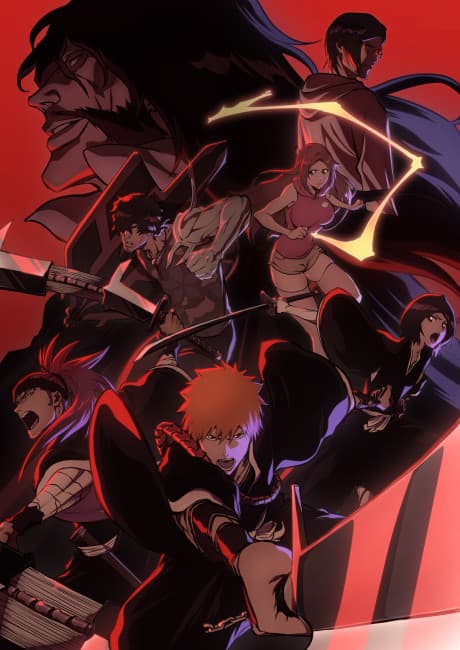
Part 2 ended on a technicality. Ichibē Hyōsube had apparently renamed Yhwach into near-nothingness, Senjumaru Shutara had apparently dismantled his entire elite guard, and the show closed the book with a nostalgic retrospective segment instead of confirming either outcome. "A," the premiere of Part 3, subtitled "The Conflict," spends its first act making clear exactly how premature that apparent victory was — and then spends the rest of its runtime showing why.
When and where to watch it
Part 3 is a bigger commitment than what came before it: where Parts 1 and 2 each ran 13 episodes, "The Conflict" is confirmed for 14, airing weekly from October 5 through December 28, 2024 in Japan. Studio Pierrot remains behind the production, with Masashi Kudo continuing on character designs and Shirō Sagisu still composing. The season also brings a notable shift at the top of the production chain: Tomohisa Taguchi, who directed every episode through Part 2, has moved up to Chief Series Director for this cour, with Hikaru Murata stepping in as episode director. Individual episode-director credits are known to rotate across the season's back half, so it's worth treating any single-episode attribution within this run with some caution rather than assuming Murata personally handled every installment. The new opening, "Kotoba ni Sezu Tomo" by SIX LOUNGE, and ending, "MONOCHROME" by suisoh, both debut with this episode. As with the previous two parts, this is a Hulu release in the US and a Disney+ release internationally — still not available on Crunchyroll.
Senjumaru's Bankai gets an anime-original showcase
"A" opens by rewinding into the fight Part 2 left hanging rather than skipping past it. Senjumaru's Bankai has trapped the Sternritter Schutzstaffel — Yhwach's elite guard — and the episode uses that setup to give her ability room the manga never quite afforded it on the page. Across the sequence, Senjumaru cycles through six distinct techniques drawn from her Bankai, an expansion that's clearly anime-original in scope: rather than a single decisive strike settling the fight in one beat, the show stretches it into a showcase of just how varied and lethal her fabric-based abilities actually are. It's the kind of choreography-first sequence Part 2's finale was already leaning on, and "A" picks up that same instinct almost immediately.
Ichibē renames Yhwach — and it isn't enough
In parallel, Ichibē Hyōsube continues the confrontation that closed out Part 2. His attempt to neutralize Yhwach hasn't changed: he renames him "Kuroari," or "Black Ant," using the same identity-rewriting technique that appeared to work in the Part 2 finale. That renaming does measurably reduce Yhwach's power — the episode doesn't walk that part back. What it does instead is reveal how much of a gap still separates a weakened Yhwach from anyone else in the fight, including someone as formidable as Ichibē.
The Almighty fully awakens
This is where "A" earns its title. Yhwach's Schrift letter — "A," The Almighty — activates in full, and the episode gives the moment real weight rather than treating it as a quick power-up beat. The Almighty grants Yhwach precognition and negation, letting him see outcomes before they happen and unmake the actions that would otherwise stop him, layered on top of what the episode frames as a near-omniscient read on the battlefield as a whole. It's presented as less an escalation of raw strength than a fundamental change in what kind of fight this even is: Senjumaru and Ichibē weren't losing to a stronger opponent so much as fighting someone who could already see how the fight ended before they'd finished their first move.
The awakening reframes everything that came before it in the episode. Senjumaru's six-technique showcase and Ichibē's renaming both looked, in the moment, like they were working. The Almighty's activation is the show's way of clarifying that they were only ever working because Yhwach was still holding back — and that the version of him capable of precognitive, near-omniscient battle awareness was never actually threatened by either of them to begin with.
Uryū defeats Senjumaru
Once Yhwach's power surges with the Almighty fully online, the fight's momentum flips almost immediately. Uryū Ishida, still fighting as one of the Sternritter under circumstances the show has kept deliberately ambiguous, defeats Senjumaru in direct combat. It's a hard reversal from where the Part 2 finale left things, and it lands with particular weight given how much of the season has been built around uncertainty over where Uryū's true loyalties actually sit — a fight he wins decisively does nothing to resolve that ambiguity on its own.
Ichibē's death, and a name spoken aloud
The episode's most dramatic single beat belongs to Ichibē. With the Almighty active, Yhwach kills him outright, beheading him in a moment the show doesn't soften. But Ichibē's power has always been built around names — it's the same mechanic he used to strip Yhwach's identity down to "Kuroari" in the first place — and that same logic is what lets him survive his own death. Ichibē has Ichigo say his name aloud, and using that borrowed energy, he reconstructs himself from the beheading. It's a beat that only works because the show spent Part 2 establishing exactly how central names are to Ichibē's ability; here, that groundwork pays off in the most literal way possible, with his own name and Ichigo's willingness to speak it functioning as the thing that rebuilds him.
About that recycled footage
Worth flagging plainly rather than glossing over: roughly nine minutes of "A" reuses or directly recaps footage from Part 2's finale. Given that the episode is explicitly picking up the same fight where Part 2 left off, some overlap is a defensible structural choice — but the scale of it, nearly a third of a standard episode's runtime, is a real production decision worth noting rather than something to skip past. It's a big part of why the episode's pacing reads as sluggish to some viewers, and it factors directly into how the episode was received critically, covered below.
The cliffhanger: Ichigo arrives as Yhwach reaches the Soul King
"A" closes on its biggest swing yet. As Ichibē is mid-reconstruction and the fight with Senjumaru and Uryū resolves, the episode cuts to Ichigo arriving at the Royal Palace — just as Yhwach stabs the Soul King directly. It's the premiere's clearest signal that Part 3 isn't going to spend much time easing back into the story: the season's central antagonist reaches the one goal the entire war has been building toward, in the same episode that just finished re-establishing where every other major fighter stands.
How it was received
Reaction to "A" was genuinely mixed, and the recycled footage is close to the center of nearly every review.
InBetweenDrafts' Travis Hymas scored the episode 5 out of 10. He found things to like in some of the fan-service beats — writing that certain stretches felt like "this is the Bleach I remember" — but was critical of how much runtime went to reused Part 2 footage, calling it a real pacing problem. He also wasn't won over by the Almighty itself, finding Yhwach's ability dramatically uninteresting compared to what Sōsuke Aizen's power brought to the table earlier in the franchise. His overall assessment was blunt: the episode "does very little to move the story forward."
CBR scored it 6 out of 10, with a headline that framed the premiere as "a mediocre premiere for an epic season." The outlet's criticism zeroed in on the same nine minutes of recycled footage, noting it arrived with no creative additions to justify reusing it. At the same time, CBR was genuinely complimentary about the episode's craft — praising the animation, direction, and music as "artistic feats to behold," and singling out the voice work as a strength. Where the review turned critical was on substance: the battles were described as feeling perfunctory and predictable, and the episode was said to lack real characterization for a premiere carrying this much weight.
The Geekiary didn't publish a numeric score but landed in a similar place tonally. The outlet praised Senjumaru's expanded Bankai showcase as genuinely inventive, singling it out as a highlight of the episode. But it was more critical of how the antagonists ultimately won their fights, arguing that Uryū's win over Senjumaru and the Almighty's overall dominance read more like raw power scaling than anything tactical — calling the resolution "uninspired."
Across all three, the pattern holds: craft and specific sequences (Senjumaru's Bankai variety, the production values generally) are getting real credit, while the episode's use of recycled footage and its comparatively thin characterization are the recurring sticking points.
Bottom line
"A" is a premiere that spends a lot of its runtime revisiting ground Part 2 already covered before finally pushing forward — and when it does push forward, it does so with a genuinely big reveal in the Almighty's full awakening, a real gut-punch in Ichibē's death and reconstruction, and one of the season's biggest cliffhangers yet in Ichigo's arrival at the Royal Palace. But the nine minutes of reused footage are a real structural drag that multiple outlets flagged independently, and the fights that do move forward — Uryū over Senjumaru, the Almighty overwhelming both of Yhwach's opponents at once — landed for some critics as scale over substance. Part 3 has fourteen episodes to work with this time instead of thirteen, and after an opener this transitional, it needs "Kill the King" to actually spend that runtime.
Episode 2, "Kill the King," picks up mid-cliffhanger with Ichigo already inside the Royal Palace and Yhwach's blade already through the Soul King — expect the fallout to reshape the rest of the season's stakes almost immediately.