Bleach TYBW Part 3 Episode 3 Recap: "The Dark Arm" Explained
Full spoilers for Bleach: Thousand-Year Blood War Part 3 ("The Conflict") Episode 3, "The Dark Arm." If you haven't watched, stop here.
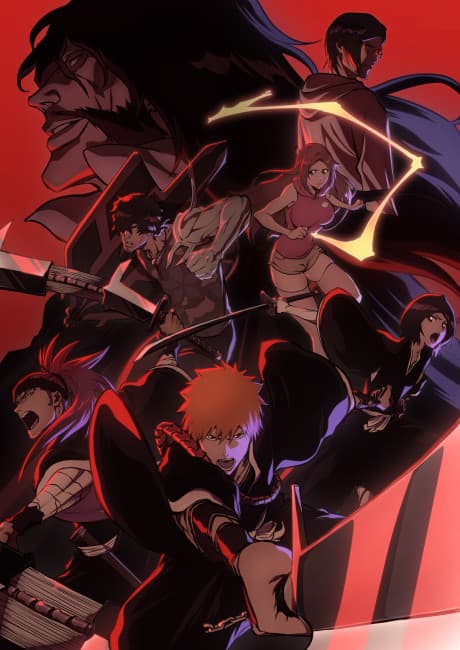
Captain Jūshirō Ukitake has been dying, slowly and visibly, for the entire run of Bleach. "The Dark Arm," the third episode of Thousand-Year Blood War Part 3, finally explains why — and does it through one of the most anime-original stretches the adaptation has attempted yet. It's also an episode that critics agree gets the "why" beautifully right while rushing straight past the "what happens because of it."
When and where to watch it
"The Dark Arm" is Episode 3 of Thousand-Year Blood War Part 3, subtitled "The Conflict," which ran October 5 – December 28, 2024 in Japan across 14 episodes under Studio Pierrot's own numbering for the cour. Tomohisa Taguchi continues on as Chief Series Director for this final stretch, with Hikaru Murata credited as this cour's episode director, Masashi Kudo returning on character designs, and Shirō Sagisu once again scoring. As with the rest of the adaptation, this is a Hulu title in the US and a Disney+ title internationally — it has never streamed on Crunchyroll.
Picking up after the Soul King's death
Episode 2 ended with the Soul King's death, and "The Dark Arm" opens in the immediate wreckage of that event. The Soul King's power was never centralized in one body alone — parts of it existed as severed limbs scattered across the Soul Society cosmology, each with its own independent will and history. This episode is built around one of those limbs specifically: Mimihagi, the entity referred to here as the Soul King's right hand. With the Soul King himself gone, whatever role Mimihagi has quietly played in the background for centuries comes due, and it comes due through Ukitake.
The episode frames this as a ritual — Ukitake's death isn't presented as a battlefield casualty but as something closer to a debt being called in, tied directly to Mimihagi and the Soul King's passing. It's a quiet, cosmic way to take out one of the series' longest-running supporting characters, and it's also the setup for the episode's real centerpiece.
The childhood flashback, and why it's the heart of the episode
The bulk of "The Dark Arm" is given over to an extended, anime-original flashback to Ukitake as a terminally ill child. It shows his parents, desperate and out of options, carrying him to Mimihagi's shrine as effectively a last resort. What follows is the origin of everything longtime viewers already knew about Ukitake without ever being told why: Mimihagi grants the boy's wish to survive, and in doing so becomes the reason Ukitake lived to adulthood at all — and the reason he spent his entire life as a soul reaper visibly, chronically unwell, coughing blood in the middle of battles the original series never explained beyond "he's sickly."
That detail retroactively recontextualizes a piece of characterization that's been sitting in plain sight since Bleach's earliest arcs. Ukitake's illness was never just flavor text; it was the price of a bargain made when he was a child, one he likely never fully understood the terms of himself. The flashback doesn't rush through this — it takes real time with the desperation of his parents at the shrine, and with Mimihagi's own reaction to being confronted with it.
That reaction is worth sitting with on its own. Mimihagi is written and animated here as something genuinely moved by what it witnesses — not a detached cosmic mechanism dispensing power, but an entity visibly affected by the scale of a family's desperation. That choice does a lot of work: it reframes the ritual sacrifice at the center of the episode's present-day plot as something with real emotional history behind it, rather than an abstract cosmological rule the show is asking the audience to accept on faith.
Decades of friendship, told in miniature
Woven through the childhood material is a look at the decades-long friendship between Ukitake and Shunsui Kyōraku, the two captains whose bond has been a fixture of Bleach's background texture since the original series without ever getting this kind of direct attention. The episode uses the flashback structure to let that friendship breathe — giving weight to a relationship that's mostly existed in the margins of prior arcs, shown rather than told, right up until the point where one half of that pairing is gone and the other is left to carry what comes next as the newly seated Captain-Commander.
It's genuinely strong material, and it's the piece of "The Dark Arm" that both major reviews single out as the episode's high point — more on that below.
Shunsui visits Aizen in his cell
Running in parallel to all of this, the episode shifts to Shunsui Kyōraku — now Captain-Commander in the wake of the previous Captain-Commander's death earlier in the series — making a visit to Sōsuke Aizen in his prison. The scene plays as a contingency conversation: with the Soul King dead, the Quincy threat still active, and Soul Society's command structure destabilized, Shunsui is weighing whether the imprisoned Aizen, of all people, represents a resource worth using.
It's a tonally jarring cut from the shrine flashback that dominates the rest of the runtime, and that whiplash — moving from Ukitake's most vulnerable, human moment straight into calculated wartime strategizing with the series' most notorious villain — is exactly the structural issue critics flagged with this episode. More on that below as well.
What the episode leaves unresolved
"The Dark Arm" doesn't spend much time on the immediate aftermath of Ukitake's death within Soul Society itself — there's little room given to how the rest of the Gotei 13 processes losing him, and notably little to Rukia Kuchiki, Ukitake's own lieutenant, despite her direct personal stake in his death. That gap is one of the specific criticisms leveled at the episode's structure, discussed in more detail in the reception section below.
How it was received
Reaction to "The Dark Arm" was broadly positive but consistent on one specific complaint: the episode's emotional payoff and its plot mechanics are pulling in opposite directions.
InBetweenDrafts scored the episode 8 out of 10, writing that "'The Dark Arm' trades pacing for characterization" by prioritizing emotional depth over plot movement. The outlet called it "not as good as last week's episode" but still "another strong showing" overall, while also flagging structural pacing issues at the start of the episode and questioning why Rukia — Ukitake's own lieutenant, with obvious personal stakes in his death — was sidelined given how directly relevant she is to what's happening.
CBR was more pointed in its critique, scoring the episode 7 out of 10 under a headline arguing that the episode undermined a fan-favorite character's death. CBR praised the anime-exclusive flashback material specifically, arguing the direction on that stretch of the episode actually surpasses its manga source material — high praise for an adaptation this far into its run. But the outlet was sharply critical of how the episode handles the present-day fallout, writing that "'The Dark Arm' rushes past Ukitake's death to focus on Aizen's return setup," denying the moment the emotional resonance it had otherwise earned. CBR's own words put it bluntly: "'The Dark Arm' barely gives the characters and audiences time to mourn Captain Ukitake, let alone process everything he just revealed about himself." The review explicitly draws an unfavorable comparison to how Part 1 handled the death of Captain-Commander Yamamoto, which got a multi-episode send-off rather than being compressed into a single episode alongside an unrelated plot thread.
Taken together, both reviews land on the same throughline from different angles: the Ukitake childhood material is some of the strongest anime-original work this adaptation has produced, but the episode's decision to immediately pivot into Shunsui-and-Aizen setup undercuts the death it just spent so much care building toward.
Bottom line
"The Dark Arm" is an episode of two very different halves. One is a patient, genuinely moving piece of anime-original storytelling that finally explains a detail Bleach left unaddressed for its entire run — why Ukitake was sick his whole life, and what that cost had to do with Mimihagi, the Soul King's right hand, and a childhood bargain struck at a shrine. The other is a rushed pivot into wartime contingency planning, using Ukitake's death as a springboard into Shunsui's visit to Aizen's cell rather than as a moment the show is willing to sit with. Both InBetweenDrafts and CBR landed on strong-but-flawed scores for exactly that reason: gorgeous, surpassing-the-manga material on one side, and a death that doesn't get the room to breathe on the other. Whether that imbalance gets addressed once the dust settles is a question Episode 4, "The Betrayer," will have to start answering.
Episode 4, "The Betrayer," picks up the fallout from Ukitake's death and Shunsui's prison visit to Aizen, with Soul Society still reeling from the Soul King's death and the question of who — or what — steps into the power vacuum it left behind.