Bleach TYBW Part 2 Episode 7 Recap: "I Am the Edge" Explained
Full spoilers for Bleach: Thousand-Year Blood War Part 2, "The Separation," Episode 7, "I Am the Edge." If you haven't watched it yet, stop here.
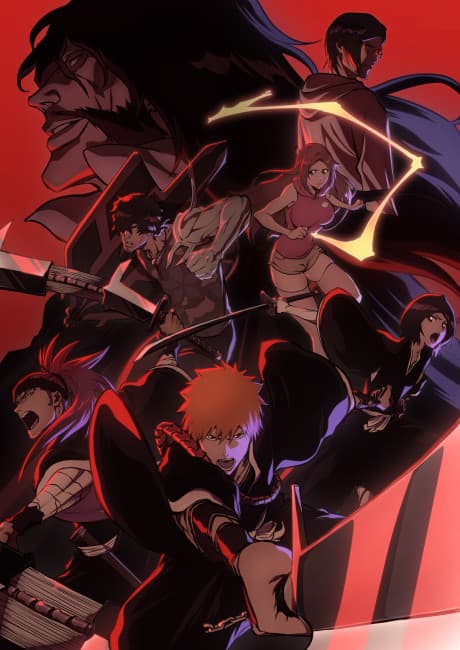
Kenpachi Zaraki has spent most of Bleach: Thousand-Year Blood War off the board, sent away to train while the rest of the Gotei 13 absorbed hit after hit from Yhwach's Sternritter. "I Am the Edge" is the episode that brings him back, and it doesn't waste the moment — Zaraki gets a Sternritter whose entire power is built around imagination itself, and the fight becomes the clearest showcase yet of exactly what makes him different from every other captain in this war.
When and where to watch it
Bleach: Thousand-Year Blood War Part 2 streams on Hulu in the US and on Disney+ internationally; this adaptation has never streamed on Crunchyroll, which still catches some viewers off guard. Part 2, subtitled "The Separation," aired its Japanese broadcast run between July 8 and September 30, 2023, with "I Am the Edge" landing roughly in the middle of that run — sources place the episode's air date around August 19 or 20, 2023, though accounts differ by about a day. Studio Pierrot uses its own episode numbering for this cour rather than continuing the count from earlier seasons, so this is Episode 7 of Part 2. Tomohisa Taguchi directs, Masashi Kudo remains character designer, and Shiro Sagisu returns as composer, the same production team that has carried the series since its 2022 premiere.
Gremmy Thoumeaux: a Sternritter who imagines his enemies to death
The episode's central conflict is Zaraki against Gremmy Thoumeaux, one of Yhwach's Sternritter, whose ability lets him manifest whatever he imagines directly into physical reality. In practice, that means Gremmy isn't limited by conventional Quincy techniques or weaponry at all — over the course of the fight he conjures missiles, drops meteors, and, in the episode's most extreme escalation, imagines a literal vacuum of space around his opponent. It's a power with essentially no hard ceiling, which is exactly what makes it dangerous against most fighters: if Gremmy can picture something happening to you, it can happen to you.
That's also what makes the matchup against Zaraki so interesting on paper. Gremmy's power depends on scale and creativity outpacing whatever his opponent can physically withstand or react to. Against a captain who fights on pure instinct and overwhelming physical force rather than technique or strategy, that equation doesn't play out the way it does against anyone else Gremmy has faced.
Zaraki as Gremmy's "perfect counter"
And that's precisely how the fight goes. Rather than getting overwhelmed by the sheer variety of threats Gremmy throws at him, Zaraki simply cuts through each one directly — missiles, meteors, the vacuum of space itself, all handled the same way: with his blade, head-on, without hesitation or any particular concern for the scale of what he's facing. The framing of the episode makes the point explicit, positioning Zaraki as something close to Gremmy's perfect counter. A power built on imagination and escalating scale runs into a fighter whose entire philosophy is to meet whatever's in front of him with more force and more resolve than the threat can generate, and it simply doesn't matter how big or strange the imagined weapon is if the person swinging back refuses to be intimidated by it.
It's a satisfying structural choice for a character who has spent so much of the series as a wildcard — Zaraki's return isn't just "the strong guy shows up," it's a fight specifically built to demonstrate why his particular brand of relentlessness is the right tool for this particular problem.
The Nozarashi reveal
The episode's biggest story beat is Zaraki finally revealing his Shikai's true form and true name for the first time: Nozarashi, a massive cleaver-type blade. It's a reveal that's been a long time coming for the character — Zaraki has fought through most of the series without ever formally naming or unlocking the true form of his own sword, a detail that's always set him apart from every other captain in the Gotei 13. The episode ties the reveal directly to Yachiru, connecting the moment to her in a way that gives it emotional weight beyond simple power escalation, rather than treating it as a pure spectacle beat divorced from the character relationships that have quietly shaped Zaraki's arc all along.
For longtime viewers, this is the kind of reveal that's been anticipated for years, and the episode does deliver it. Whether the pacing gives it the space it deserves is a separate question — one that reviewers, discussed below, weren't shy about raising.
The twist: Gremmy is a brain in a jar
Once Zaraki's blade finally lands, the episode pulls its last card: physically, Gremmy Thoumeaux is revealed to be nothing more than a brain in a jar. The body viewers have been watching move, taunt, and conjure meteors throughout the fight isn't his actual physical form at all — it's another product of his own imagination-made-real ability, projected outward while his real, vulnerable body sits elsewhere, reduced to the barest possible physical presence. It's a genuinely unsettling image to close the fight on, and it recontextualizes the entire battle retroactively: even the "him" that Zaraki has been fighting the whole episode was itself an act of imagination.
A note on the performance
One detail critics flagged in discussing the episode is Gremmy's voice performance. InBetweenDrafts specifically noted that voice actor Natsuki Hanae brings mannerisms to Gremmy that recall his other, far more famous role: Tanjiro Kamado in Demon Slayer. That's worth framing carefully — it's one critic's subjective read on the performance, not anything confirmed by the production itself, but it's an observation that's likely to stick with viewers who know Hanae primarily from that other role, given how differently Gremmy is written compared to Tanjiro.
How it was received
Reception to "I Am the Edge" landed on the mixed side, with critics largely agreeing on the fight's core ideas while disagreeing on whether the episode gave them enough room to breathe. Anime News Network's Nicholas Dupree was the more critical voice, describing the episode as "overstuffed" from a pacing standpoint and arguing that Gremmy came across as "irritating when he should be intimidating" — a character whose concept should read as genuinely threatening undercut by an adaptation pace that didn't give the threat time to settle in before the fight resolved. Dupree's broader argument was that the rushed adaptation undercut the thematic weight the fight was clearly reaching for, particularly around Zaraki's arc.
InBetweenDrafts took a somewhat more measured view, noting that the fight was resolved efficiently within the runtime it was given, but argued that a single fight built around a power this conceptually rich "absolutely would have benefited from an injection of more screen time" as anime-exclusive expansion. On the Nozarashi reveal specifically, the outlet noted that fans had anticipated the moment as a likely highlight of the episode going in, and that the episode "delivers this payoff, though the brevity somewhat diminishes its impact" — a fair summary of the episode's overall reception: the right ideas, arguably too little time to let them land the way they deserved to.
No confirmed key-animator or specific sakuga credits for this episode were found in coverage, so it's worth being cautious about crediting the fight's visual highlights to any one specific animator without a sourced attribution.
Why the pacing critique makes sense here
It's easy to see why critics zeroed in on runtime rather than the fight's underlying ideas. Gremmy's power is genuinely one of the more conceptually interesting abilities the series has introduced — a threat with no fixed shape, defined entirely by however much the character in front of the camera is willing to imagine. That kind of power benefits from being drawn out, from letting the escalation actually feel escalating rather than compressed into a handful of set pieces before the twist ending arrives. Layer Zaraki's Nozarashi reveal, easily one of the most anticipated character beats left unresolved in the entire war, into that same compressed runtime, and it's not hard to see why reviewers felt the episode was carrying more than a single episode's worth of material could comfortably hold.
Bottom line
"I Am the Edge" gives Kenpachi Zaraki his first real spotlight in Thousand-Year Blood War, and the ideas underneath it are strong: a Sternritter whose power is functionally limitless run headfirst into a captain whose answer to everything is more force and less hesitation, capped by a Nozarashi reveal tied to Yachiru and a genuinely unsettling brain-in-a-jar twist. Where the episode stumbles, according to critics, is pacing — cramming a conceptually rich fight and one of the series' most anticipated reveals into a single episode left both feeling somewhat compressed. It's a fight worth watching for what it finally gives Zaraki, even if reviewers are right that it could have used more room to land.
Episode 8, "The Headless Star," moves the war forward again, with the fallout from Zaraki's fight and Yhwach's forces regrouping likely to shape whatever confrontation comes next.