JoJo's Bizarre Adventure: Steel Ball Run Returns to Netflix September 25 With 2nd and 3rd Stage
Light spoilers for Steel Ball Run's premise and the shape of its story so far. Nothing beyond what Netflix's own announcements and the franchise's early setup already establish.
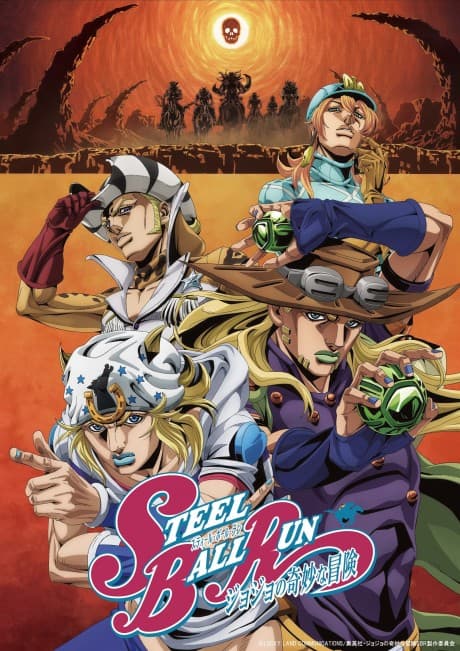
JoJo's Bizarre Adventure: Steel Ball Run is coming back into weekly rotation. Netflix confirmed that the next batch of episodes — described in the platform's own materials as the season's "2nd Stage" and "3rd Stage" — begins streaming September 25, 2026, with new episodes releasing weekly on Fridays. It's the first real continuation since the adaptation's unusual launch back in March, when Netflix dropped a single standalone episode and then went quiet for months.
What's confirmed for September 25
According to Netflix's Tudum and ComicBook.com, the upcoming release batch totals 11 episodes, arriving weekly rather than in one lump binge drop. That's a notable structural choice for a Netflix anime release specifically, since the platform has more commonly favored full-season dumps for its anime slate — Netflix's own scheduling here is treating Steel Ball Run closer to a traditional simulcast than a binge title, at least for this stretch of the season.
The "2nd Stage" and "3rd Stage" framing comes directly from Netflix, and it lines up with how the first episode was positioned back in March — as a standalone premiere rather than the start of a continuous weekly run. Whatever the internal reasoning for the naming, functionally it means the season has now been broken into at least three separate release windows: the March standalone episode, and this 11-episode block beginning in September.
New cast confirmed for this batch
ComicBook.com reports several new Japanese cast additions tied specifically to this release window. Tomoaki Maeno has been cast as Mountain Tim, Tomokazu Sugita will voice Funny Valentine, and Yoko Hikasa is set to play Hot Pants. All three are characters who become central to Steel Ball Run's story once the race moves past its earliest stretch, and their casting reveal alongside a concrete premiere date suggests these characters are expected to have real screen time within this specific 11-episode batch, rather than being held back for a later season.
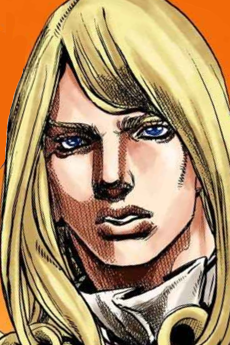
Sugita's casting as Funny Valentine is likely to draw particular attention from longtime fans, given how prominent a role the character plays across the rest of Steel Ball Run's story. Funny Valentine is also a JoJo's Bizarre Adventure part-first — the first American president to appear as a major figure within the franchise's central cast of antagonists — which makes his casting reveal one of the more consequential pieces of news in this rollout, even without any story details attached to it yet.
On the English dub side, Daman Mills and Damien Haas are confirmed to return as Johnny Joestar and Diego Brando respectively, continuing in the roles they originated for the March premiere. English cast for the newly revealed Japanese roles — Mountain Tim, Funny Valentine, and Hot Pants — has not yet been announced, which tracks with how dub casting for ongoing Netflix anime releases has typically trailed a step or two behind the original Japanese reveals.
The rest of the returning cast
Rounding out the cast carried over from March, the Japanese voice cast includes Shogo Sakata as Johnny Joestar, Yōhei Azakami as Gyro Zeppeli, Rie Takahashi as Lucy Steel, Kenta Miyake as Steven Steel, and Kaito Ishikawa as Diego Brando. On the English side, Kaiji Tang voices Gyro Zeppeli alongside Mills and Haas. None of these roles are reported as recast for the new batch, meaning the core cast established at the March premiere carries through into this next stretch of episodes intact.
Who's behind the camera
David Production continues as the animation studio, keeping the adaptation in the same house that's handled JoJo's Bizarre Adventure since Diamond Is Unbreakable. Yasuhiro Kimura and Hideya Takahashi are credited as directors, with Toshiyuki Kato serving as series director. Yasuko Kobayashi, a veteran of adapting dense, long-running source material, handles series composition, while Daisuke Tsumagari is the character designer. Yugo Kanno composes the score, and Yoshikazu Iwanami directs sound.
That's largely the same production backbone that's carried the franchise's prior parts to screen, which matters for a series like Steel Ball Run — a soft reboot of the JoJo's Bizarre Adventure timeline with an entirely new cast of leads, but one that still leans on the studio's accumulated experience with the franchise's specific blend of stylized action and Stand-based combat.
Why the season got split up in the first place
The gap between March's standalone premiere and September's 11-episode batch has an explanation straight from the production side. Producer Noriko Dohi told ComicBook.com that the horse-race sequences central to Steel Ball Run's plot demand an unusual amount of production work to pull off convincingly. "The horse races, especially, need to feel really real and that's incredibly difficult," Dohi said, framing the difficulty of animating the races as the specific reason the season was broken into separate release blocks rather than airing as a continuous run.
That's a fairly candid piece of context for a production team to share, and it reframes the March-to-September gap as a deliberate production decision rather than a scheduling accident. Steel Ball Run's central hook is a transcontinental horse race, which means galloping horses, race formations, and constantly shifting terrain are baked into nearly every episode rather than being an occasional set piece — the kind of recurring, motion-heavy animation work that's genuinely difficult to produce at a consistent weekly pace without either compromising quality or building in extra lead time between batches.
Catching up: what Steel Ball Run is actually about
For anyone who caught the March premiere and hasn't thought about the show since, or who's coming to this news cold, here's the shape of the story. Steel Ball Run is set in 1890 and follows a transcontinental horse race held across the United States, with a $50 million prize on the line for whoever finishes first. Johnny Joestar, a paraplegic former jockey, enters the race and ends up partnered with Gyro Zeppeli, a fellow competitor who wields a technique called "Spin" — a rotational energy that, among other effects, temporarily restores Johnny's ability to move his legs.

That premise sets Steel Ball Run apart structurally from most of the rest of JoJo's Bizarre Adventure. Rather than being framed primarily around Stand battles from the outset, the story starts as a race narrative first, with the deeper Stand-based conflicts and the story's stranger, more cosmic elements folded in gradually as the race itself gets more dangerous. It's also worth knowing, for newcomers, that Steel Ball Run functions as something closer to a soft reboot within the franchise's internal continuity — a new timeline with new versions of the Joestar and Zeppeli names, rather than a direct continuation of the earlier parts' cast.
What's still unconfirmed
It's worth being clear about what hasn't actually been locked down here. At least one outlet has reported, citing leaks rather than an official source, a much longer projected rollout — something in the neighborhood of 42 to 43 total episodes spread across 2026 through 2028, with this September's 11-episode batch as just the first piece of that larger plan. That figure is explicitly framed as a leak in its own reporting, not as something Netflix or the production committee has confirmed, and it shouldn't be treated as a settled schedule. What is confirmed, from Netflix's own materials and corroborated by ComicBook.com, is the September 25 start date and the 11-episode count for this specific batch — nothing beyond that has been officially locked in.
Similarly, no source has specified exactly where in the manga's story this 2nd and 3rd Stage batch is expected to begin or end. Given the split-cour structure and the production emphasis on the race sequences, it's reasonable to expect this batch to push meaningfully further into the story than the March premiere alone did, but without an official chapter or arc breakdown from Netflix or David Production, any more specific claim about story coverage would be speculation.
Bottom line
Steel Ball Run's next stretch of episodes — Netflix's "2nd Stage" and "3rd Stage" — starts streaming September 25, 2026, with 11 episodes releasing weekly on Fridays. The rollout comes with confirmed new cast in Tomoaki Maeno, Tomokazu Sugita, and Yoko Hikasa, a returning English dub anchored by Daman Mills and Damien Haas, and an explanation from producer Noriko Dohi for why the season has been split into pieces rather than airing straight through: the horse races are simply too demanding to produce on a continuous weekly schedule. With the March premiere now half a year in the rearview mirror, this is the first real test of whether Steel Ball Run can sustain a consistent release cadence going forward.
Expect weekly episodes every Friday starting September 25, covering what Netflix is framing as the '2nd Stage' and '3rd Stage' of the season — 11 episodes in total. Further cast reveals, particularly for the English dub's new characters, are likely as the premiere date approaches. Reports of a longer multi-year rollout stretching into 2027 and 2028 have circulated from at least one outlet citing leaks, but that timeline hasn't been confirmed by Netflix or the production committee and shouldn't be treated as settled.